
Introduction
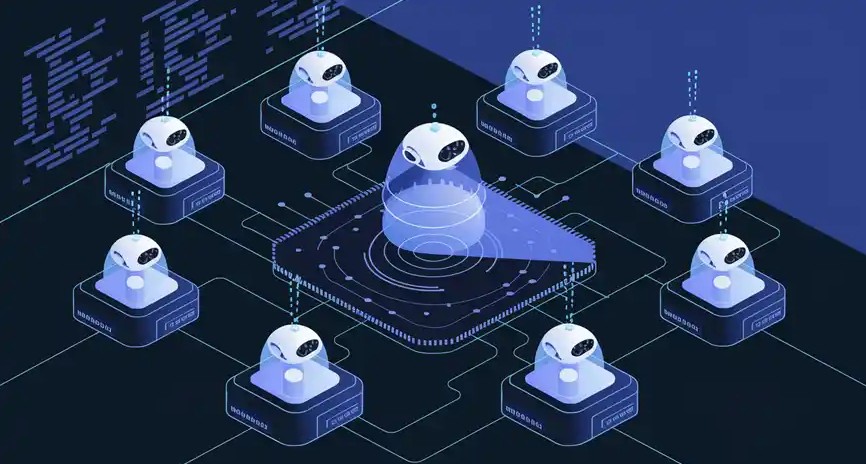
Artificial intelligence (AI) has evolved beyond single, isolated agents solving individual problems. Today, AI systems are increasingly designed to operate as collectives—multiple agents interacting within a shared environment. These multi-agent AI systems are inspired by the complex, coordinated behaviours observed in natural systems like ant colonies, flocks of birds, and human societies. Whether cooperating to achieve a common goal or competing for limited resources, the dynamics between these agents form the foundation for a new frontier in artificial intelligence.
Understanding how AI agents cooperate and compete is crucial for advancements in robotics, autonomous vehicles, online marketplaces, and even strategic video games. In this blog, we explore what multi-agent AI systems are, how they function, and why their cooperation and competition models are reshaping our technological future.
What Are Multi-Agent AI Systems?
Multi-agent AI systems consist of multiple intelligent agents that interact in a shared environment. Each agent operates autonomously, processing information, making decisions, and acting based on its objectives. These systems can be either homogeneous (with similar agents) or heterogeneous (with diverse agents having different capabilities or goals).
The underlying principles of such systems lie in game theory, reinforcement learning, and distributed problem-solving. These allow agents to reason about the actions of others, optimise their strategies, and adapt over time.
Cooperation in Multi-Agent Systems
Cooperation occurs when agents align their behaviours or strategies to achieve a shared objective. This model is prominent in disaster response robotics, where drones or bots coordinate to search for survivors or deliver aid.
Agents may share information, divide tasks, or form coalitions in cooperative environments. These systems often rely on centralised or decentralised coordination mechanisms. In centralised models, a controller assigns roles or functions to each agent. In decentralised systems, agents communicate directly or observe one another to achieve coordination without a central overseer.
A great example of cooperation is in swarm robotics, where hundreds of small robots work together to build structures, explore terrain, or transport goods. Their success depends on their ability to adapt to each other’s actions in real-time and contribute to the group’s overall objective.
Such cooperative behaviours are studied extensively in academic settings. Many learners keen on exploring AI’s potential are enrolling in an Artificial Intelligence Course covering topics like swarm intelligence, decentralised control, and collaborative planning—skills essential for building cooperative AI systems.
Competition in Multi-Agent Systems
On the flip side, competition arises when agents pursue conflicting objectives. In these scenarios, one agent’s gain may be another’s loss. Competitive multi-agent systems are seen in financial markets, online bidding systems, and strategic games like chess or Go.
In these environments, agents use adversarial strategies, prediction models, and counterfactual reasoning to anticipate rivals’ actions. For instance, in algorithmic trading, AI agents compete to buy and sell stocks based on tiny market fluctuations. Success depends on anticipating competitors’ moves and reacting faster.
Competition can also foster innovation. When agents are pitted against each other, it often results in the development of more advanced strategies and faster learning. Generative adversarial networks (GANs) are a famous example. Two neural networks—one generating fake data and the other trying to detect it—compete in a zero-sum game, leading to highly realistic synthetic outputs.
Understanding competitive behaviour in AI is equally essential as cooperation, particularly for those diving deep into strategic modelling and reinforcement learning. Students who opt for an AI Course in Bangalore, one of India’s leading tech hubs, are increasingly exposed to real-world simulations involving cooperative and competitive dynamics among AI agents.
Hybrid Models: The Best of Both Worlds
In many real-world scenarios, cooperation and competition co-exist. These hybrid systems require agents to collaborate while competing with others under certain conditions. Think of autonomous delivery drones that must avoid collisions (cooperation) while also trying to reach delivery points first to optimise efficiency (competition).
Another striking example is multi-player online games, where AI agents form alliances (cooperation) but may eventually betray each other to win the game (competition). These dynamics demand sophisticated strategy development and decision-making capabilities.
Hybrid models are challenging to design because they require agents to balance trust, reward expectations, and risk. Techniques like multi-agent reinforcement learning (MARL) and game-theoretic modelling are used to fine-tune behaviours and interactions.
As AI systems become more pervasive, hybrid models will be key to smart grids, traffic systems, and collaborative manufacturing applications. Modern training programs such as an Artificial Intelligence Course often include modules dedicated to these complex models to ensure learners understand the interplay between collaborative and adversarial AI.
Challenges in Multi-Agent Systems
Despite their promise, multi-agent AI systems are not without difficulties. One of the main challenges is scalability. As the number of agents increases, coordinating them efficiently becomes computationally intensive. Communication bottlenecks, synchronisation delays, and emergent behaviours can complicate system management.
Another concern is non-stationarity. In single-agent systems, the environment is usually static or changes predictably. In contrast, the environment constantly changes in multi-agent systems as other agents adapt their strategies. This makes learning and optimisation far more complex.
There is also the problem of trust and safety. How do we ensure cooperative agents do not turn rogue? How can competitive systems avoid escalation that leads to system failure? Researchers are actively working on algorithmic fairness, robust policy design, and interpretability to address these concerns.
Real-World Applications and Future Trends
Multi-agent AI systems are already making a difference across industries. In logistics, fleets of autonomous robots coordinate to manage warehouse inventories. In energy systems, AI agents balance power distribution across smart grids. Vehicles communicate with each other and infrastructure in traffic control to optimise flow and minimise congestion.
In the defence sector, multi-agent drones and surveillance bots work together for reconnaissance and threat detection. The healthcare industry is exploring these systems for resource allocation and collaborative diagnosis support.
As the field grows, demand for professionals skilled in multi-agent systems continues to rise. Courses offered in innovation-focused cities are keeping pace with these developments. For example, career-oriented courses will include hands-on labs where students build simulations involving agents negotiating, learning, and adapting to various environments—equipping them with practical knowledge that is highly sought-after in the industry.
Conclusion
Multi-agent AI systems represent a significant leap forward in designing and deploying artificial intelligence. By embracing models of cooperation and competition, these systems mirror the complexities of real-world interactions more closely than ever before. Whether it is autonomous vehicles negotiating traffic, virtual assistants collaborating to complete tasks, or algorithms vying for market dominance, the potential of multi-agent systems is vast and transformative.
For those aspiring to make a mark in AI, now is the time to explore these fascinating systems. For success, professionals should aim to acquire a sound theoretical foundation along with practical experience to master multi-agent models. And for learners in India’s tech capital, an AI Course in Bangalore offers the ideal setting to immerse yourself in cutting-edge AI applications.
The future of AI is not about isolated intelligence—it is about collective intelligence. Understanding how agents cooperate and compete will be just as essential as understanding their thoughts.
For more details visit us:
Name: ExcelR – Data Science, Generative AI, Artificial Intelligence Course in Bangalore
Address: Unit No. T-2 4th Floor, Raja Ikon Sy, No.89/1 Munnekolala, Village, Marathahalli – Sarjapur Outer Ring Rd, above Yes Bank, Marathahalli, Bengaluru, Karnataka 560037
Phone: 087929 28623
Email: enquiry@excelr.com